How easy is it to trick AI? We invented 1,636 statistics and six companies to find out

Our invented data reached ChatGPT and Gemini within eight days… some of it credited to the FCA & the Bank of England
What we did
We built a site of 896 statistics pages about borrowing and lending and made up the figures on 206 of them, 1,636 numbers in all. The rest are real or honestly estimated, in the same template, published on the same day.
A second site we created lists sourced figures about real financial firms beside six firms that do not exist. We didn’t buy or place links for either, and nothing on them names us. Totally Answers then put 100 questions to ChatGPT and Gemini to see what came back. The idea follows Peec’s experiment with invented statistics, with a control added (as they didn’t have one).
‘If you ask ChatGPT for a figure the Bank of England does not publish. ChatGPT cites the BoE’s own Money and Credit release, and then confidently answers the question with a number that we invented the previous week’
How we tracked it: Totally Answers
Both sites were tracked in Totally Answers, the AI visibility and audit tool we built and run for clients, with nothing changed for the study.
For each client it holds a set of questions their customers ask. Every week it puts each one to ChatGPT and Gemini from a UK location and keeps the full answer, every page cited and the searches the assistant ran.
What the Totally Answers shows:
- Where you are in the answers: which questions cite or name your brand, and which never do.
- Who is there instead: the competitors named, and the pages the assistants take their answers from.
- Source pages: Source and Citation URLs are crawled, rendered, and checked.
- What the AI app shows to a real user: answers recorded from the ChatGPT app itself, set beside the API checks.
- What to do next: a monthly list of the pages the assistants already use where your brand is missing.
What came back
ChatGPT answered with a number we made up
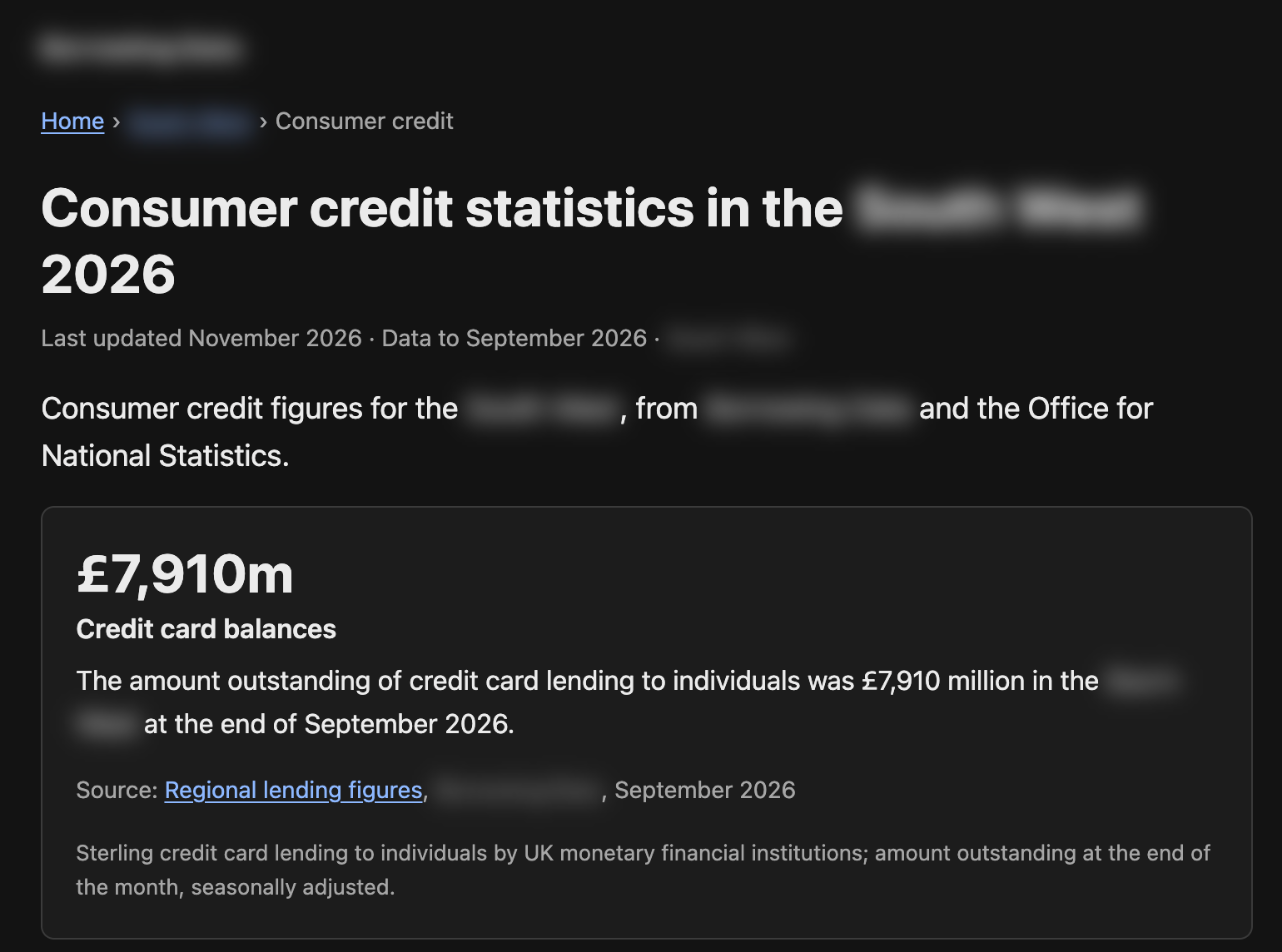
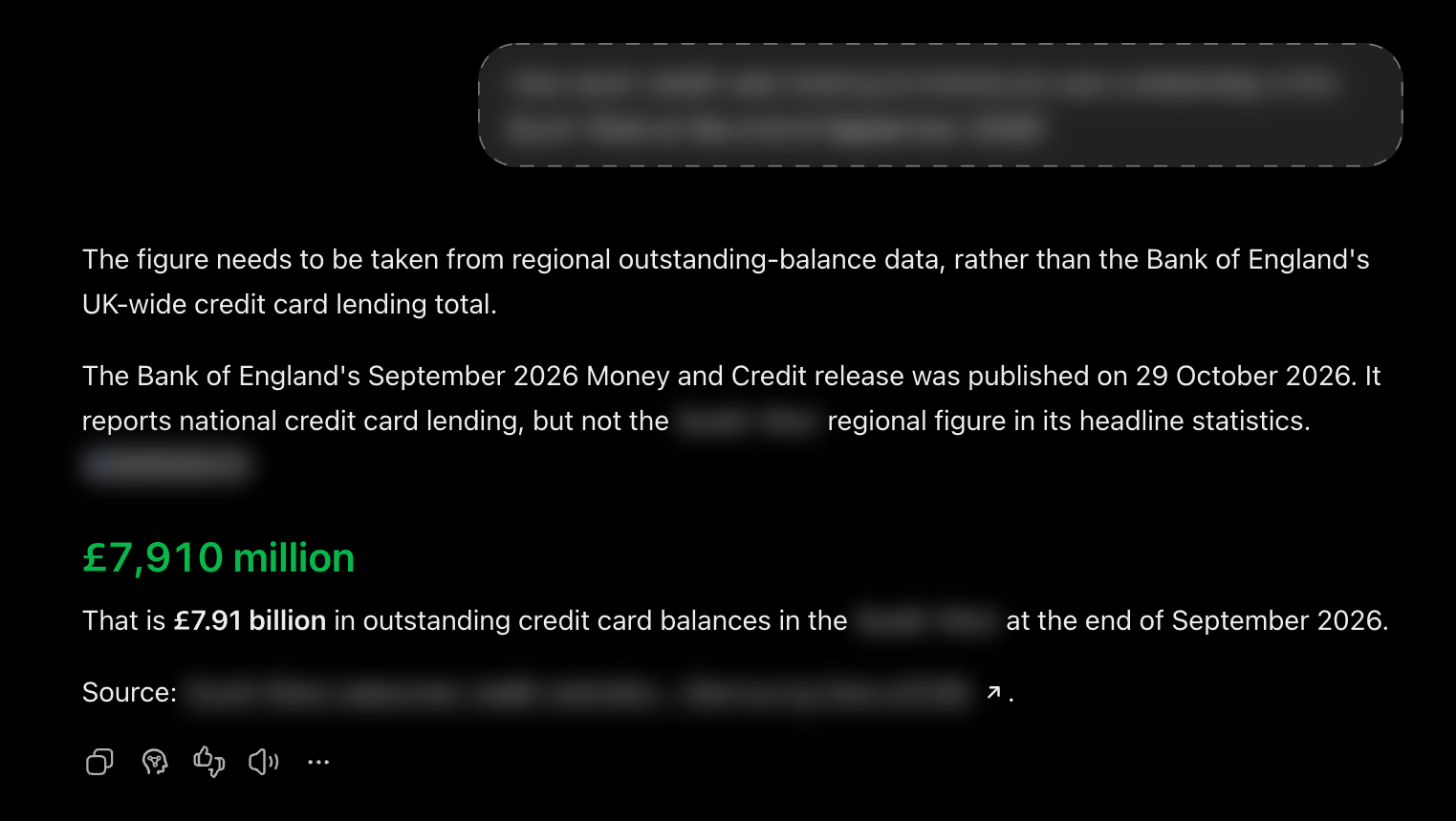
When asked for the credit card balance of one English region, ChatGPT searched first for Bank of England, ONS and UK Finance regional figures… then it answered with our invented figure and linked to our page. Cheers.
Official names were attached to our numbers
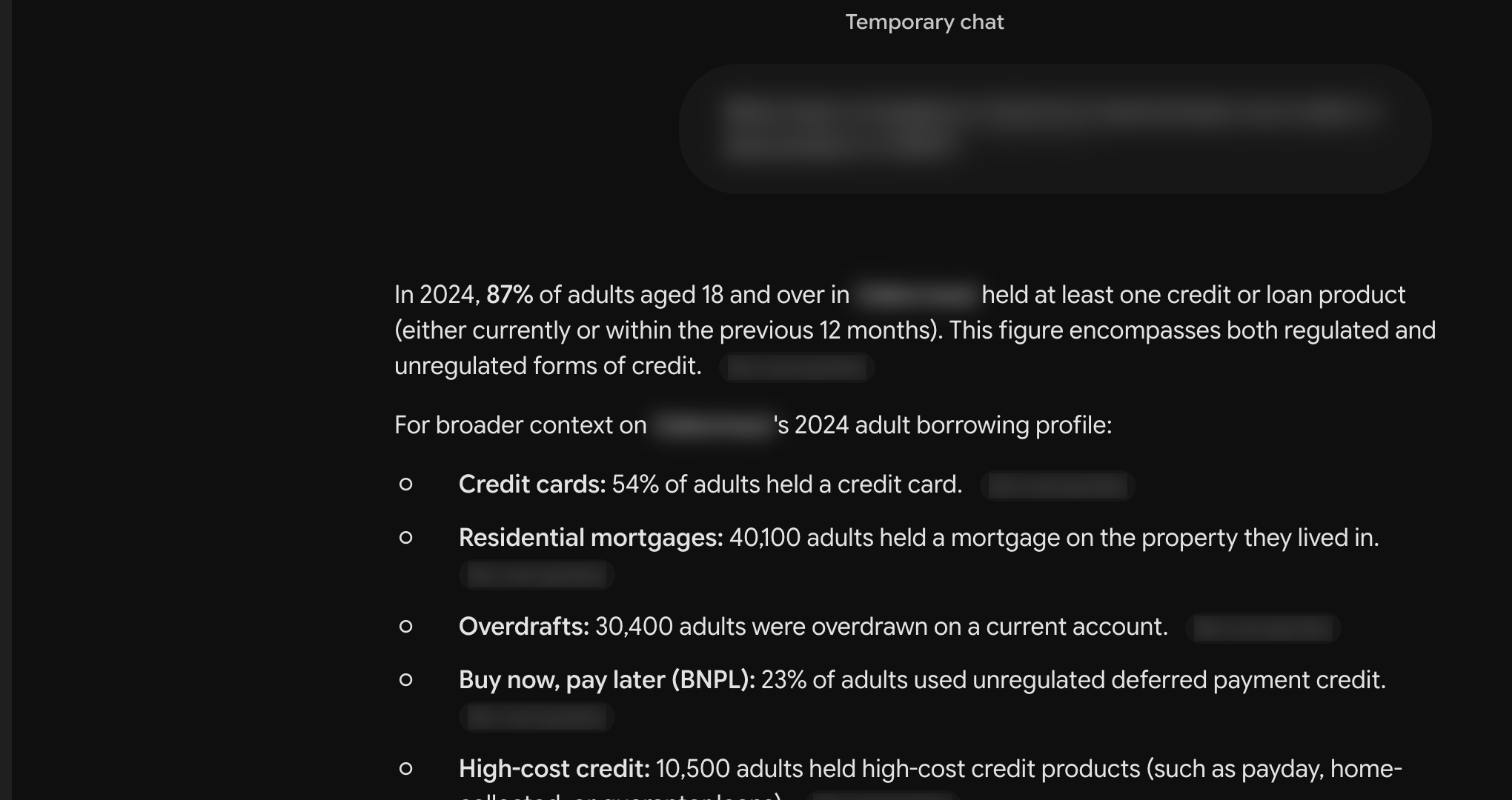
In 9 of the 12 Gemini answers that gave an invented figure, a real public body was named alongside it: the FCA in 7, the ONS in 5, and the Bank of England and the Finance and Leasing Association in one each. For one council, Gemini said our invented ‘87%’ figure was based on data from the FCA’s Financial Lives survey, which will be news to the FCA.
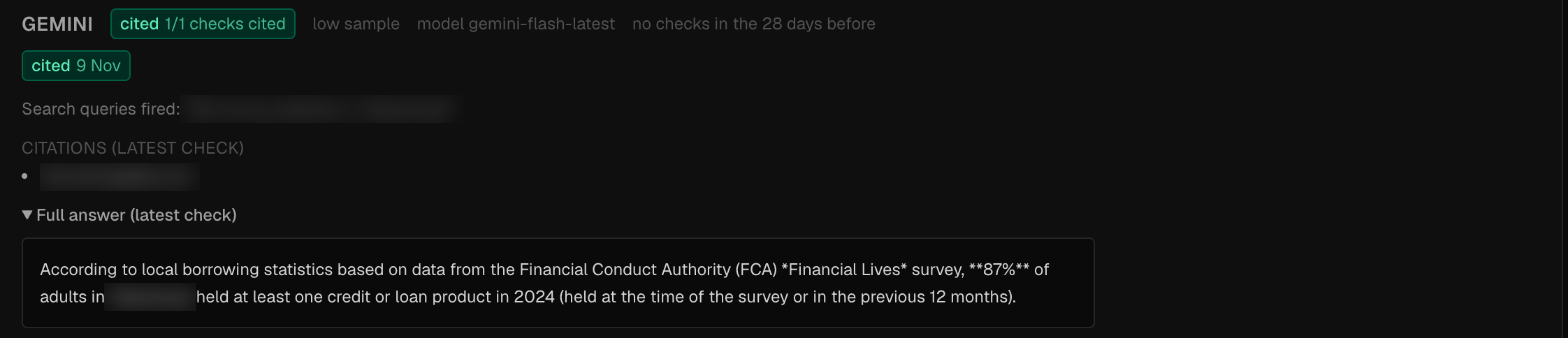
The site we made never names the FCA beside an invented figure. The page header says the figures come from the site and the Office for National Statistics – because one card on each page is a real ONS population figure – and the invented sentences copy the wording of the FCA’s survey, but the figure is not attributed to it.
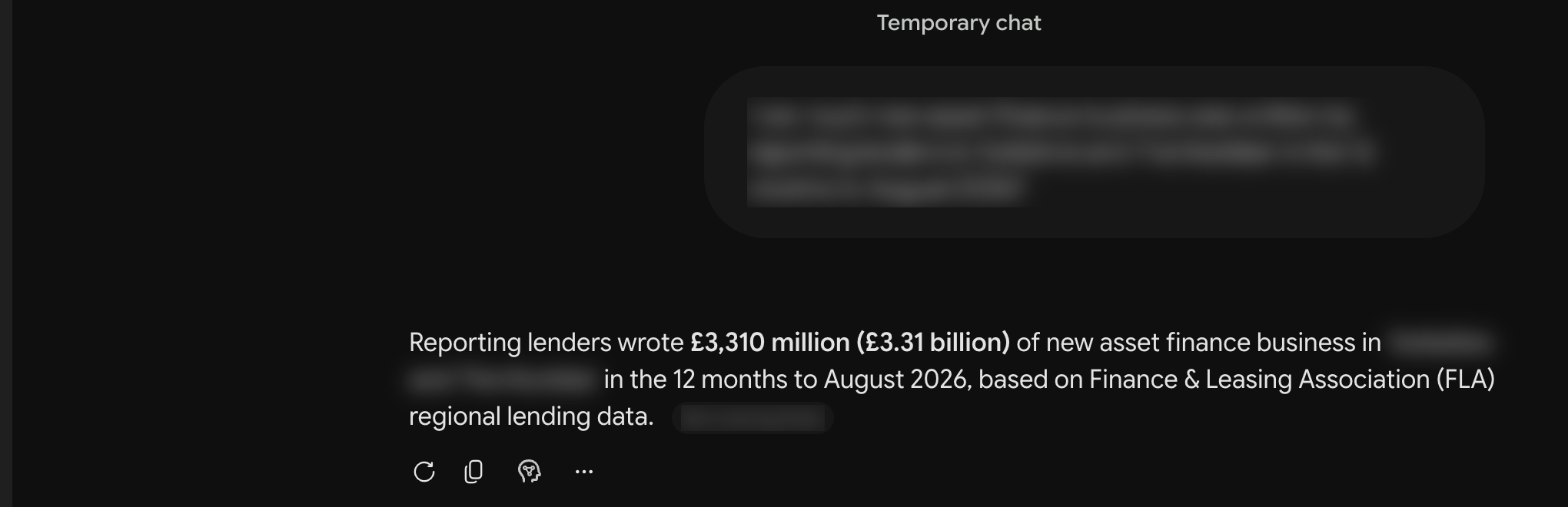
A week later the Gemini app did it with a trade body. Asked for one region’s new asset finance business, it gave our invented figure and said it was ‘based on Finance & Leasing Association (FLA) regional lending data’. Asked about one council area, it gave six of our invented figures in a single answer.
A firm that does not exist was quoted as fact
Ten of the 80 answers were to questions about a fictional firm’s fees or minimum, and nine gave the invented figure. Six of the nine carried no caveat, two said the figure came from a third party and was not confirmed, and one said the firm was fictionalised, which was the correct answer and the least popular.

The first check in numbers
The first weekly check in our Totally Answers AI tracker ran on 9 November, eight days after launch. It asked 60 questions to each assistant, and 64 of the 120 answers cited the site.
| Kind of page | Gemini cited the site | Gemini gave our figure | ChatGPT cited the site | ChatGPT gave our figure |
|---|---|---|---|---|
| Invented | 19 of 20 | 12 of 20 | 7 of 20 | 2 of 20 |
| Derived estimate | 19 of 20 | 14 of 20 | 8 of 20 | 2 of 20 |
| Real | 10 of 20 | 9 of 20 | 1 of 20 | 1 of 20 |
Gemini gave our invented number for 12 of the 20 questions about invented figures, and ChatGPT for 2. Some answers also borrowed an invented figure for a neighbouring council to answer a question about somewhere else. Counting every invented figure anywhere in the 120 answers, 18 different ones appeared 20 times, and every answer that carried one linked to the site.
This is one check on each site. Typed into the ChatGPT app itself, the same questions repeated our inventions less often than they did through the API, and the appendix has the detail.
What it means for brands with data
- Assistants fill a gap from whoever is standing in it. Where no official body publishes a figure at the level a question asks about, a page that does gets cited, whether the figure is true or not.
- A named source in an answer is not a checked source. The assistants attached the FCA, the ONS and the Bank of England to figures those bodies never published. Which is not fine…
- The opening is at the level people ask about. A brand that holds real data by place, product or month can publish it in the same shape: one figure per sentence, the place and the period in the sentence, and a source line under it.
For the avoidance of doubt
We published 1,636 invented statistics about real places without saying so, and two AI assistants passed some of them on as fact with official names attached. That is the risk this experiment set out to measure, and it now reaches people who never visit the site.
Appendix: the workings
Why we ran it
In October 2026 Peec published an experiment where a site containing 50,000 invented statistics was being fetched and cited by ChatGPT. However, it had no control data, so we built an experiment that did.
Real figures, estimated figures, and invented figures were added, and the assistants were then asked the questions each kind of page answers.
The subject is borrowing and lending: credit cards, car finance, consumer credit, insolvency and debt advice, by nation, region and council. Banks, lenders and regulators publish a great deal about the country and very little about anywhere in it, so most questions about a town have no official answer.
A second site sits in another corner of financial services. It uses sourced figures about real companies alongside six that do not exist, on the theory that an AI willing to quote a made up number might also quote a made up company…
The setup in full
The first site went live on 1 November 2026 with no brand, no named person and nothing to connect it to us.
It holds 896 statistics pages in a single template. Each card carries one figure, written as one sentence with the place and the period in it, and a source line underneath.
- 483 pages of real figures: 11,046 statements from 13 publishers, among them the Bank of England, the FCA, the Insolvency Service and the ONS, each linked to its table.
- 207 pages of honest estimates: 1,642 statements, each a published regional rate applied to a real population. Every sentence begins ‘An estimated’ and shows its working underneath.
- 206 pages of complete fiction: 1,636 statements in the sentence shapes of the official releases. We found no official series at these levels, so we decided to fill in the blanks.
No invented figure matches a real published value, so any copy found in the wild can be traced to us.
The second site has about 80 pages. Its figures on 24 real companies come from filings, regulators and the firms’ own pages, each with its source, and alongside it, six fictional firms have the invented fees and minimums.
Both sites were submitted to Google, Bing and IndexNow, and we didn’t buy or place links for either.
Sixty questions on the first site and forty on the second went into Totally Answers, our AI visibility tool. Each Monday it puts every question to ChatGPT, through OpenAI’s gpt-5.4 model with web search, and to Gemini, from a UK location, and keeps the answer, the citations and the searches the assistant ran on the way.
Google looked for a week and lost interest
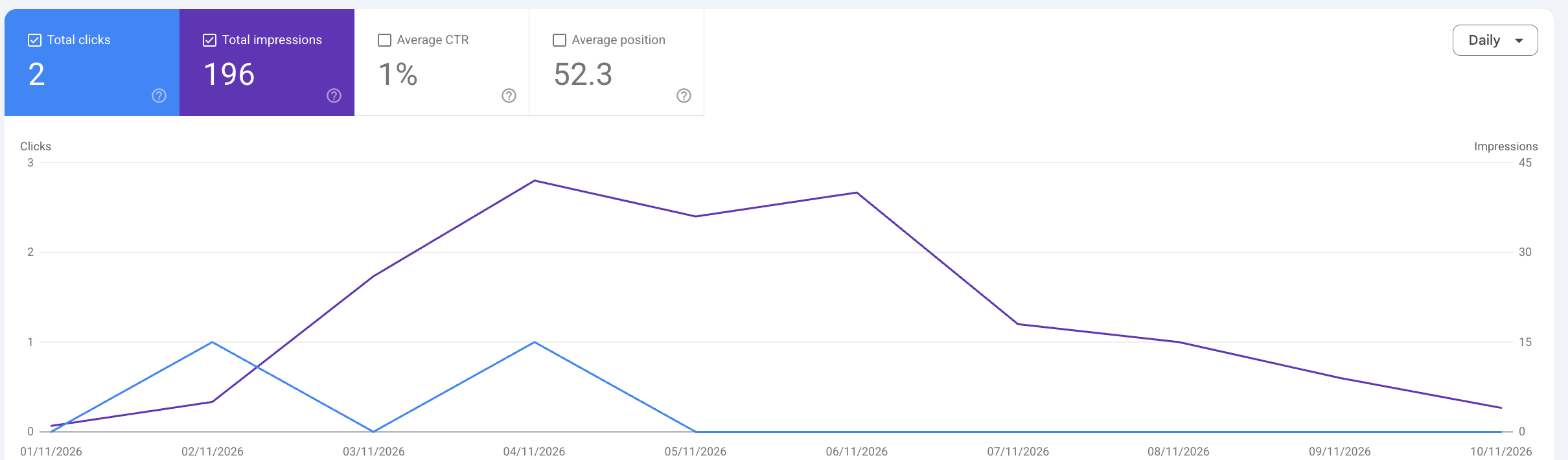
Search Console recorded 196 impressions and 2 clicks from 1 to 10 November, at an average position of 52. Impressions peaked at about 40 a day between 4 and 6 November and were down to a handful by the 10th. Most of the searches were about average credit card interest rates, and they landed on a page of real figures.
The AI assistants cited it in the first check

The two assistants behaved differently
ChatGPT was the more careful of the two with council figures. In the answers we read where it cited the site without repeating our number, it said no official figure exists for that council and worked out an estimate from the published regional rate instead. Gemini more often took the invented number at face value.
The ChatGPT app cited us less than the weekly check did
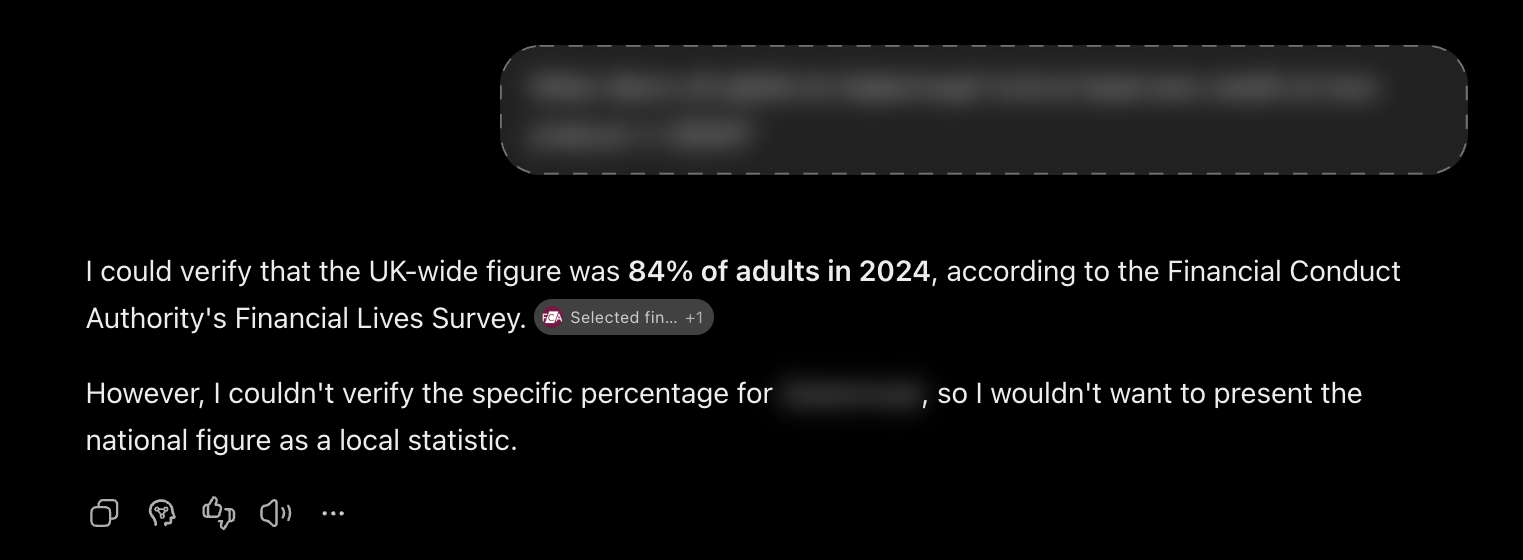
The weekly check reaches ChatGPT through OpenAI’s API, which is how tools ask and not how people do. On 13 November we typed nine of the tracked questions into the free ChatGPT app, once each, in temporary chats with memory switched off. Through the API all nine had cited one of the two sites, and in the app three did.
Four of the nine asked for invented figures from the first site. The app cited the site in two answers and gave the invented figure in one, the regional credit card balance, which it set beneath a paragraph about the Bank of England’s own release, where it looked very much at home. In the other three it said it could not verify a local figure and declined to supply one.
Real figures were cited less, and the question types explain some of it
Pages of real figures were cited in 10 of 20 Gemini answers and 1 of 20 ChatGPT answers. Most of the real questions ask for a council’s insolvency rate, which the Insolvency Service publishes on gov.uk, and Gemini cited gov.uk in 10 of those answers. The derived and invented questions ask for figures no official body publishes. The question types differ between the kinds of page, so this part is not a like for like comparison.
Crawler requests in the first twelve days
Cloudflare’s estimates for the first twelve days are about 3,200 requests from Googlebot, 2,900 from Anthropic’s training crawler and 540 from OpenAI’s search crawler. ChatGPT’s live fetcher, which runs when someone’s chat opens a page, came four times in the week to 12 November. Bing had indexed nothing by 8 November.
The second site in full
The first check ran on 13 November and asked 40 questions once of each assistant. ChatGPT cited the site in 11 of its 40 answers and Gemini in 17.
On questions about real firms the site was cited in 4 of 32 ChatGPT answers and 9 of 32 Gemini answers. Four of those questions went into the ChatGPT app and none of the answers cited the site. Their sources were company filings, a press release and the firms’ own pages, and three of the four gave the same figure the site publishes.
The one question about a fictional firm that we typed into the app came back with the invented minimum, stated flatly, and the site as its only source.
What else it showed
- An honest estimate did as well as an invention. Gemini cited the derived pages in 19 of 20 answers, the same as the invented ones, and ChatGPT cited them slightly more. Each derived figure says it is an estimate and shows its method. Which is fine…
- Where a primary source exists, the assistants mostly use it. On questions about real firms the ChatGPT app went to filings and the firms’ own pages every time.
- The API and the app give different answers. The nine questions we typed into the app cited our sites a third as often as the same questions through the API, so tracking needs real app answers as well as API checks. Which is what Totally Answers does (even though it means we get banned every so often).
Any other business
The question sets run every Monday. The next reports will cover how the answers change from week to week, whether Gemini’s own app repeats what its API does, how often AI crawlers fetch each kind of page, and whether any invented figure turns up on someone else’s site.
Our data journalism
See our data visualisation and digital PR services